The landscape of digital publishing across the United Kingdom has undergone a dramatic structural shift over the past several years. When generative AI models and automated text synthesisers were first introduced to the mainstream market, corporate communications departments, digital media companies, and educational publishers rushed to integrate them into their daily production workflows. The immediate financial appeal was obvious: production costs dropped significantly, and content volume multiplied exponentially overnight. This initial wave of rapid automation led many superficial market analysts to predict the swift end of traditional professional content development.
However, entering 2026, a profound counter-evolution has taken root within premium digital spaces. The unbridled enthusiasm for purely automated text generation has hit a wall of practical reality. UK platforms that chose to replace human expertise completely with automated software algorithms are experiencing unprecedented drops in organic search visibility, collapsing click-through rates, and a measurable decay in audience loyalty. The digital ecosystem has reached a point of absolute content saturation, where billions of generic, uninspired paragraphs are published daily into a crowded online space.
In response to this crisis of quality, forward-thinking British digital strategists are executing an intentional editorial pivot. The solution to standing out in a crowded market isn’t to increase automated output, but to strategically reinvest in premium, invisible human talent. To maintain high authority and protect core digital assets from severe platform updates, leading agencies and publishers rely on professional ghost writers to deliver authoritative, primary-source-driven material.
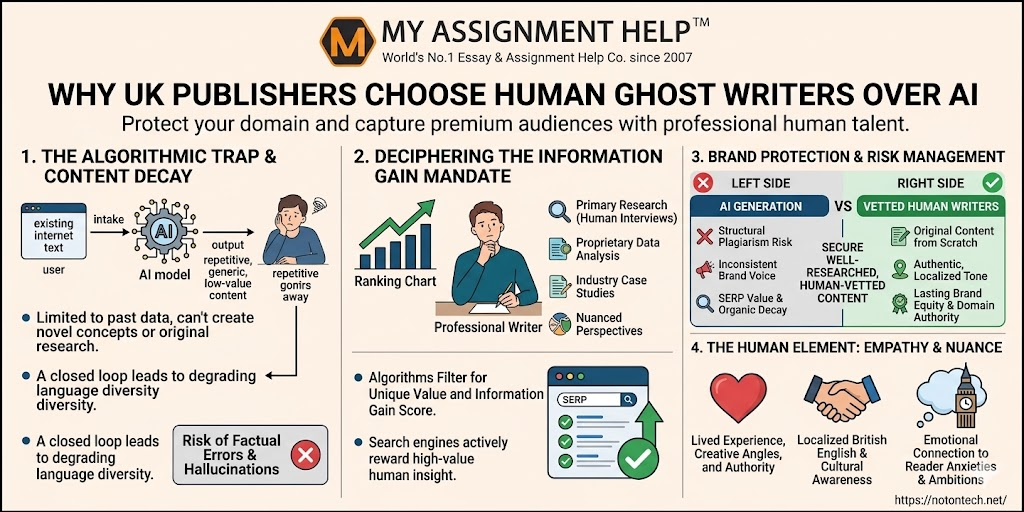
The Algorithmic Homogenisation Trap and Content Decay
To understand why premium human intervention has become a critical operational necessity, one must examine the mathematical and mechanical limitations of generative text engines. Large Language Models do not possess conceptual understanding, genuine intelligence, or real-world experience. At their core, they are highly sophisticated probabilistic sequence predictors. When prompted to generate an article, the model analyses historical data from its pre-existing training corpus and calculates the statistical probability of which word should logically follow the previous one.
This mechanical reliance on historical probability leads directly to what data scientists call “algorithmic homogenisation.” Because the software can only output the statistical average of what has already been published on the internet, it is structurally incapable of producing a novel concept, discovering a breakthrough strategy, or providing a unique perspective. The model cannot conduct a live interview with a industry leader, analyze a proprietary company dataset, or bring real-world experiential context to a narrative.
When an entire industry adopts these automated tools, it triggers a destructive phenomenon known as content decay. Web platforms begin publishing text synthesized from existing web pages, which are themselves trained on previously generated automated text. This closed loop leads to a rapid degradation of language diversity, technical depth, and factual reliability. Audiences quickly notice the lack of substance, resulting in high bounce rates and a sharp drop in brand trust. Human writing professionals break this cycle of decay by introducing lived experiences, dynamic creative angles, and authentic, real-time authority into the text.
Deciphering the Search Engine Quality Mandate
The technical shift back to human expertise is heavily reinforced by modern search engine architecture. Discovery platforms have completely rewritten their evaluation frameworks to address the flood of low-effort, automated content filling the web. The modern ranking paradigm focuses on identifying authentic information and burying repetitive, synthesized text.
The primary mechanism governing this filtering process is the “Information Gain Score.” This metric evaluates exactly how much unique value, net-new data, or distinct conceptual perspective a newly published document adds to the search engine’s existing index on that specific topic. If an article merely rehashes the same points found on the top ten ranking pages, its Information Gain score drops to zero, and the page is systematically demoted or excluded from search results entirely.
Professional human content creators naturally maximize this score. When a seasoned human expert approaches an article, they draw upon distinct industry case studies, practical problem-solving methodologies, and nuanced cultural understanding. This high-value human insight creates a robust piece of content that search engines actively reward for providing clear value to the end user.
The Specialised Writing Niche: Complex Technical Industries
The necessity of human author intervention is amplified when corporate brands must produce content for deeply analytical or highly technical sectors. While an algorithmic tool might easily draft a superficial list of marketing tips, it completely fails when faced with specialized disciplines like medicine, corporate law, or industrial STEM fields.
For example, when global engineering operations seek to publish educational documentation or industry guides on process simulation software, automated tools struggle to connect abstract math with practical safety configurations. Because writing for these fields demands advanced academic precision, outsourcing documentation or seeking specialized Chemical Engineering Assignment Help is standard practice for publishers needing flawless technical verification.
Brand Protection, Structural Integrity, and Corporate Risk Management
For UK corporate entities and educational brands, using unvetted automated writing tools creates significant institutional risks. The legal, regulatory, and reputational dangers of unverified text generation are becoming a major concern for corporate compliance teams.
[Corporate Content Development Framework]
├── Low-Tier: Automated Text Generation (High volume, high risk, declining SERP value)
└── Premium Tier: Vetted Human Writers (High authority, full compliance, lasting brand equity)
The first major risk is factual unreliability. Generative engines routinely experience “hallucinations”—instances where the algorithm creates plausible-sounding but completely fabricated statistics, legal precedents, or technical claims. In high-stakes fields like legal, financial, or corporate publishing, publishing a hallucinated fact can instantly destroy corporate credibility and invite severe compliance penalties.
The second challenge is the complex issue of copyright and intellectual property. Because automated models are trained on scraped data, their outputs often skirt the line of structural plagiarism, generating text that closely mimics protected human works. Vetted human writers ensure absolute originality. They construct arguments from scratch, cite external sources properly, and maintain a consistent, authentic brand voice that protects the organization from plagiarism risks.
The Human Element: Empathy, Subtext, and Regional Nuance
Beyond technical accuracy and search engine optimization formulas, writing is a fundamentally human act of connection and persuasion. To influence a premium audience, change a reader’s mind, or clearly explain a complex corporate transition, text must contain empathy, emotional intelligence, and an understanding of subtext.
Automated writing tools have never experienced professional pressure, managed a corporate crisis, or built a business from the ground up. They cannot understand the underlying anxieties, ambitions, or emotional drivers of your target audience. Consequently, automated text often feels detached, sterile, and unpersuasive.
Furthermore, communication standards vary dramatically across different global regions. A business white paper designed for a corporate boardroom in London requires a fundamentally different tone, stylistic restraint, and vocabulary than an informal blog post written for a tech startup in California. Elite human writers excel at managing these delicate linguistic variations. They weave in subtle cultural references, utilize appropriate regional formatting, and ensure that the content resonates deeply with the specific target demographic without sounding robotic or forced.
Conclusion: Securing Long-Term Domain Value
The rapid evolution of writing technologies has not made the professional writer obsolete; instead, it has elevated their strategic importance. By automating the production of low-tier, repetitive text, the digital market has created a massive premium on deep analytical writing, original research, and authoritative storytelling.
The future of digital publishing belongs to brands that treat content as a core asset rather than a cheap commodity. By pairing advanced research tools with the irreplaceable insights of elite human writers, modern UK organizations can build highly visible, trusted digital platforms that easily withstand algorithmic changes and deliver lasting value to their audiences.
See also: How Technology Is Transforming Manufacturing
Frequently Asked Questions (FAQ)
1. How do human writers protect a brand from search engine penalties?
Human writers focus heavily on original research, unique viewpoints, and high information gain. Modern search algorithms are explicitly designed to reward content that adds new value to the web, while penalizing or filtering out generic, repetitive text.
2. What are the primary risks of using unverified AI tools for corporate content?
The biggest risks include factual errors (hallucinations), structural plagiarism, a loss of distinct brand voice, and severe drops in search visibility due to content quality downgrades.
3. Why is British English localization important for UK-focused campaigns?
Localized spelling, idioms, and tonal awareness build immediate trust with a UK audience. It signals that the content was crafted by an expert who truly understands the regional market and local compliance standards.