| On This Page 1. The Real Problem: One Word, Two Very Different Builds 2. Ready-Made Uber Clone Script vs Custom Development 3. The Features That Actually Define an Uber Clone 4. The Modern Uber Clone Tech Stack and Architecture (2026) 5. Why Most Uber Clones Fail 6. Cost, Timeline, and Where India Fits 7. Real Case Study: A Custom, Scalable Marketplace Build 8. How to Build an Uber Clone the Right Way 9. FAQs |
Summary
Planning to build an Uber clone? Our software product development services help founders build scalable ride-hailing platforms with the right architecture from day one. Most teams are not just asking for a clone; they are looking for a product that can handle real users, traffic, and growth. A low-cost template may launch quickly, but it often fails when scaling. The right technology decisions in the first sprint can save time, cost, and rework later.
Whether you typed what is an Uber clone, ready-made vs custom Uber clone, or why do most Uber clones fail, the honest answer turns on one decision you make before any code is written. Independent market data from Statista shows ride-hailing among the fastest-growing on-demand segments, which is exactly why getting the build wrong is so expensive.
This article answers those questions with experience, not theory, and it is written the way good content should be now: human judgement on top of real delivery data, shaped around the intent behind your search rather than stuffed with keywords.
We will define what an Uber clone is, compare scripts against custom development, lay out the 2026 features and stack, and explain plainly why most clones fail and how to avoid joining them. It sits inside our wider on-demand app development guide, and it ends with a real, verified client build so you can judge the advice against work we have actually shipped.
The Real Problem: One Word, Two Very Different Builds
The phrase Uber clone hides a fork in the road, and the answer to almost every question that follows depends on which path you mean. To one founder it means a ready-made script bought for a few thousand dollars and rebranded in a week; to another it means a custom ride-hailing platform engineered for a specific city and business model.
Those are not two prices for the same thing; they are two different products with two different futures. Teams that treat them as interchangeable are the ones who later call our software development outsourcing team for an expensive rescue.
What an Uber clone actually is
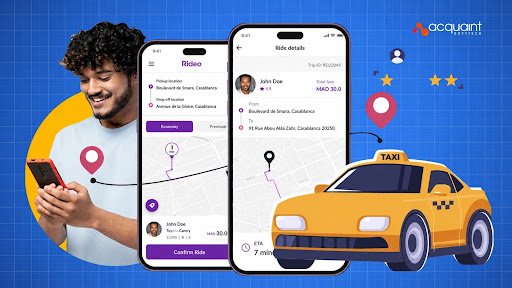
A working taxi app has three moving parts that must stay in sync in real time: the rider app, the driver app, and an admin dashboard that watches both. The difference between cheap and durable is whether those parts were built to handle one neighbourhood or one million trips, a gap we break down in our guide to taxi booking app cost. Intent matters here, because the person asking how much almost always needs to know what I am actually buying first. Answering both is the difference between a useful guide and a brochure.
The fix is to decide your category and scale before you shop for a solution. A pilot in a single town with fifty drivers has very different needs from a regional launch chasing Uber directly, and the architecture must follow that ambition, not the other way round. Mapping it during a structured discovery workshop is what prevents the rebuild that sinks most clone projects. Get the question right, and the cost answer stops being so frightening.
Ready-Made Uber Clone Script vs Custom Development
A ready-made Uber clone script gets you to market fastest and cheapest, while custom development costs more upfront but gives you a product you actually own and can scale.
A script is a finished codebase you rebrand; custom is built around your model, your city, and your growth plan. For most serious founders, the script is a prototype at best, which is why our Laravel developers are so often hired to rebuild a clone that outgrew its template within months.
| Factor | Ready-Made Script | Custom Build |
| Upfront cost | Low | Higher |
| Time to launch | Days to weeks | A few months |
| Scalability | Limited | Built to scale |
| Ownership | Vendor-locked | Full source code |
| Best for | Demo, validation | A real, growing product |
When a script is the right call
Scripts genuinely shine for validation. If you need to show investors a working demo or test demand in one area, a clone script can do that in days, and there is no shame in starting there.
The trap is mistaking that demo for a foundation, because the same code that launched fast usually cannot be extended, secured, or scaled, a pattern we describe in our on-demand delivery app development walkthrough. The hidden cost always arrives the month real users do.
Custom development flips the maths over time. You pay more at the start, but you avoid the rebuild, you control the roadmap, and you keep the source code as a company asset rather than renting someone else’s. When a script-based app hits its ceiling, the realistic options narrow to a costly version upgrade or a full rewrite. Choosing a custom early is almost always cheaper than choosing it late.
The Features That Actually Define an Uber Clone
An Uber clone needs three connected apps and a tightly defined core feature set, not a sprawling wish list. The rider app, the driver app, and the admin panel must share live data so a booking, a match, and a payment happen as one smooth flow rather than three disconnected steps.
Cross-platform delivery keeps this affordable, which is why teams hire React Native developers to ship iOS and Android from a single codebase. The core, done well, matters far more than the length of the feature list.
The non-negotiable feature set
- Real-time GPS tracking and matching: the heart of the product, pairing the nearest driver to a rider in seconds.
- Dynamic and surge pricing: fares that respond to demand, distance, and time without manual work.
- In-app payments and wallets: cards, wallets, and cash handled cleanly with receipts and refunds.
- Profiles and ratings: two-way ratings that build trust and weed out bad actors.
- Trip scheduling, history, and notifications: book now or later, with a clear record and live updates.
- Safety tools and an admin dashboard: SOS and trip sharing for users, dispatch and analytics for operators.
Beyond the basics, the features that separate a real product from a toy are the ones that handle the messy middle: cancellations, no-shows, driver allocation logic, and fraud. These are the same hard problems across the on-demand world, as our on-demand home services app guide shows in a different vertical. Skipping them to save time is exactly how a clone earns one-star reviews in its first week.
Feature scope is also where budgets quietly explode. Every small addition, scheduled rides, multi-stop trips, corporate accounts, touches the matching engine and the payment flow underneath. A disciplined project manager protecting the MVP scope is worth more than any single shiny feature. Build the core brilliantly first, then layer the rest once real usage tells you what people want.
The Modern Uber Clone Tech Stack and Architecture (2026)
A 2026 Uber clone pairs a cross-platform mobile front end with a real-time backend, a mapping layer, and a database built to scale. React Native or Flutter cover both app stores from one codebase; a Node.js or Laravel backend handles bookings and dispatch; and live location streams over WebSockets or a managed real-time service. Many builds use a MERN foundation, so founders hire MERN stack developers who can own the whole pipeline end to end.
| Layer | Recommended Tech | Role |
| Mobile apps | React Native / Flutter | Rider and driver apps |
| Backend | Node.js / Laravel | Bookings, dispatch, logic |
| Real-time + maps | WebSockets, Maps APIs | Live tracking, matching |
| Data + cloud | PostgreSQL, Redis, AWS | Scale, speed, uptime |
Architecture beats any single library
Architecture matters more than any framework you pick. Ride-hailing is a real-time, geospatial, high-concurrency problem, so the system must dispatch the nearest driver in milliseconds and survive sudden demand spikes without falling over. The backend choice between a PHP and a JavaScript stack is a genuine decision with trade-offs, which we compare in Laravel vs MERN stack. Pick for your team and your scale, not for whatever is fashionable this quarter.
The invisible layer is infrastructure, and it is where clones quietly live or die. Maps, payments, and SMS are third-party services with real costs and rate limits, and the platform needs monitoring, autoscaling, and a tested deploy pipeline around all of it. Strong DevOps engineers are what keep a launch online during a Friday-night surge. Operations and architecture, not the feature list, decide whether your app feels reliable.
Why Most Uber Clones Fail
Most Uber clones fail for business and architecture reasons, not for any lack of features. The single biggest killer is the cold-start problem: an empty marketplace with no drivers gives riders nothing to book, and no riders give drivers no reason to stay online.
Solving that needs a real launch strategy and a team that has done it before, which is why founders bring in our dedicated development teams rather than a single freelancer hoping for the best.
The five failure modes
- Cold start: launching into a market with empty supply or empty demand.
- Template debt: script code that cannot scale, secure, or be extended later.
- Weak security: loose handling of payments and live location data.
- Wrong pricing: copying Uber’s fares into a market that cannot bear them.
- Ignoring regulation and data: skipping local rules and the matching and fraud data that powers retention.
Template code that cannot scale, weak security around payments and location, and no real testing turn a fast launch into a slow death over a few months. Choosing an experienced partner avoids this, as our roundup of the best software product engineering companies explains. The market is brutal, and a buggy app loses to a reliable one every single time.
The rest of the failures are strategic and decided early. Pricing that ignores local incomes, a launch that ignores regional regulation, and a backend that captures no useful data all cap a product before it can grow.
Modern winners lean on AI development services for demand prediction, smart matching, and fraud checks, not for gimmicks. Failure is usually a decision made in month one, not a bug found in month six.
Cost, Timeline, and Where India Fits
A focused Uber clone MVP, one city, the core ride flow, and one platform typically starts in the mid-five figures, while a full multi-city platform with surge, wallets, and analytics runs well into six figures.
Timelines follow the same curve: a few months for an MVP and longer for a scaled product. Teams keep both under control by hire remote developers on a flexible model instead of carrying a fixed local payroll before revenue exists.
| Build | Typical Cost | Timeline |
| MVP, one city | From ~$40,000 | A few months |
| Growth platform | $80,000+ | 4 to 8 months |
| Multi-city, full features | $150,000+ | 8 months and up |
Why geography is the biggest lever
Geography is the biggest single lever on what you spend. India-based teams deliver the same quality at up to 40% lower cost than Western agencies, the saving documented in our story on how a startup saved $60K a year on remote hiring. That gap often decides whether an MVP has enough runway left to reach the launch that proves real demand. Cheaper hourly rates buy you more shots on goal.
Cost is not only the build, but it is the quality of the decisions around it. A wrong architecture choice can cost more than the entire MVP to undo, so senior guidance early genuinely pays for itself. A virtual CTO can set the stack, the scope, and the hiring plan before a single dollar of build money is committed. Spend on judgement first and code second, and the rest gets cheaper.
Real Case Study: A Custom, Scalable Marketplace Build
The clearest proof that custom and scalable beats ready-made is a marketplace we built from scratch for a client of Pinpoint, documented in our custom marketplace case study. It is a two-sided platform that, much like a ride-hailing app, must connect many independent sellers and buyers through one reliable system, with an admin panel managing over 100 vendors and sub-vendors. We built it custom precisely so it could grow without slamming into a template’s ceiling.
What we delivered, and why it matters
The platform supplies its data through APIs, was optimised for speed under load, and gives administrators real control over users, roles, and vendor data. Those are the exact disciplines a ride-hailing app needs for dispatch, oversight, and trust, which is why this build maps so cleanly onto an Uber clone even though the product sells goods rather than rides. Built custom, it scaled cleanly; bought as a template, it would have stalled at the first surge of vendors.
| Outcome | This Custom Build | |
| Vendors/users | 100+ managed cleanly | |
| Data handling | API-driven, real-time | |
| Performance | Optimised for speed | |
| Ownership | Full source code | |
| Verified client result (Clutch): Darren Fuller, who works at Pinpoint, described our dedicated team as always available, even on weekends, and singled out the support and communication, calling the work great value. A custom, API-driven, admin-controlled marketplace is the same shape of system a serious Uber clone requires. Acquaint Softtech holds a 4.9/5 rating from 50+ verified Clutch reviews with Premier Verified status. | ||
These are the qualities verified clients consistently highlight about us, summarised in our Clutch recognition overview. The lesson for any Uber clone is simple: the value lives in a custom, scalable system you own and keep improving, not in a template you rent for a season. A live ride-hailing platform also needs steady support and maintenance to stay fast and secure long after launch day.
How to Build an Uber Clone the Right Way
Building an Uber clone well follows a clear order, and skipping a step is what creates the failures above. The sequence runs from market and category validation, to a tight MVP scope, to the real-time core, to payments and safety, to launch and scale. Teams that need data-heavy backends sometimes hire Django developers for the matching and analytics layer, while others stay on a JavaScript stack throughout.
The build sequence
1. Validate the market and confirm the platform category before scoping.
2. Scope a single-city MVP and protect it from feature creep.
3. Build the real-time matching and tracking core first.
4. Integrate payments, maps, and safety tools.
5. Test hard for load and security before real funds move.
6. Launch, learn, then scale city by city.
Two steps decide almost everything. First, scope a true MVP: one city, the core ride loop, one platform, and resist every feature that does not serve it directly. Second, design for deployment and scale from day one, using the patterns we cover in our MERN stack app deployment guide, so the launch does not buckle under its very first surge. Everything else is disciplined execution.
There is also a middle path between a throwaway script and a from-scratch build. A properly engineered white label solution that you own and customise can give you speed without the template trap, when it is built by a team that knows ride-hailing. The right route depends on your timeline, budget, and ambition, which is precisely the conversation worth having before you write a single line of code.
FAQs
What is an Uber clone?
An Uber clone is a ride-hailing app built like Uber. It includes rider, driver, and admin applications. The platform uses GPS tracking, ride matching, and online payments.
Is an Uber clone script a good idea?
An Uber clone script is useful for testing a business idea quickly. It reduces initial development costs and launch time. However, it often struggles with scaling, security, and customization.
Why do most Uber clones fail?
Most Uber clones fail because they cannot attract enough riders and drivers. Poor scalability, weak security, and pricing issues also create challenges. Regulatory compliance is another common obstacle.
What features does an Uber clone need?
An Uber clone needs real-time ride matching and GPS tracking. It should support payments, ratings, notifications, and trip history. An admin dashboard is essential for dispatching and analytics.
How long does it take to build an Uber clone?
A basic Uber clone MVP can be built within a few months. Advanced features increase development time significantly. A scalable multi-city platform typically takes 8+ months.
Ready-made or custom Uber clone, which is better?
A ready-made Uber clone is suitable for demos and market validation. A custom solution offers better scalability and flexibility. Most growing businesses eventually choose custom development.
What tech stack is best for an Uber clone?
React Native or Flutter are popular for mobile app development. Node.js or Laravel are commonly used for backend services. PostgreSQL, Redis, and cloud infrastructure support scalability and performance.
How much does a custom Uber clone cost?
| Region | Cost |
| US | $40,000–$150,000+ |
| UK | £32,000–£120,000+ |
| Europe | €37,000–€140,000+ |